
A fridge that is not cooling is the most common reason people call us about a refrigerator. In our own job records, “not cooling” shows up in 47.6% of 5,483 fridge and freezer jobs with fault notes. Some of those calls end with a part replacement. Others turn out to be a blocked vent, a dial that got bumped or coils packed with dust.
This guide walks through the checks you can do yourself before you book a repair. It explains what each result points to, so if you do call a technician you can describe the problem clearly. It also covers keeping your food safe while you sort it out.
Key Takeaways
- Health Canada says a fridge should be at 4 °C (40 °F) or colder and a freezer at -18 °C (0 °F) or colder. A thermometer is the first check.
- Check the simple things first: power, settings, blocked vents, the door seal and dusty condenser coils.
- A cold freezer with a warm fridge usually points to an airflow problem, such as a failed fan, a stuck damper or an iced over evaporator coil.
- If both the fridge and freezer are warm and the coils are clean, the cause is more likely the condenser fan, the control board or the sealed system. That needs a technician.
- In our records, sealed system or compressor work was behind 7.2% of fridge jobs with fault notes. Most cooling problems are smaller repairs.
First, measure the temperature
Before you change anything, find out how warm the fridge really is. The display on the front shows the setting, not the actual temperature inside. Put an appliance thermometer in a glass of water on the middle shelf, close the door and read it after a few hours.
Health Canada recommends setting your fridge at 4 °C (40 °F) or lower and your freezer at -18 °C (0 °F) or lower (Health Canada: Safe food storage). Between 4 °C and 60 °C is the danger zone, where bacteria grow quickly.
If the reading is at or just above 4 °C, a settings change or a few minutes of cleaning may solve it. If it is well above that, move perishable food to a cooler with ice or a working fridge while you troubleshoot.
7 checks before you call a technician
1. Power and settings
Make sure the fridge is plugged in firmly and the breaker has not tripped. Many fridges have a showroom or demo mode that runs the lights and display with the cooling turned off. Your owner’s manual explains how to switch it off.
Check the temperature setting too. Dials and touch controls get bumped by kids, by shelves or during cleaning. After you change a setting, give the fridge 24 hours to settle before you judge it.
2. Blocked air vents inside
A frost free fridge is one that cools both compartments with a single cold coil in the freezer. A fan blows cold air from the freezer into the fridge through vents in the back or top wall. If a large container, a stack of groceries or a bag in the freezer covers those vents, the fridge side warms up while the freezer stays cold.
Move food away from the vents in both compartments and leave a little space between items so air can move.
3. The door seal
A door that does not close fully or a gasket that is torn, loose or dirty lets warm room air in all day. Close the door on a sheet of paper at a few points around the frame. If the paper slides out with no resistance, the seal is not doing its job.
Clean the gasket with warm soapy water and check that nothing inside is stopping the door from closing, such as a shelf or drawer that sticks out. Our guide to fridge door gaskets and your energy bill explains how to test and care for the seal in more detail.
4. Condenser coils and space around the fridge
The condenser coils are where the fridge gets rid of the heat it pulls out of the food compartments. On most fridges they sit underneath behind the kick plate or on the back. When they are coated in dust and pet hair, the fridge runs longer and cools less.
Unplug the fridge, then vacuum the coils with a brush attachment as your manual describes. Check that the fridge has some space around it and that nothing is blocking the vent at the bottom front.
5. Listen for the fans
With the door open, most frost free fridges pause the inside fan. Close the door, or press the door switch by hand if it is safe to reach, and listen for the fan in the freezer. Then listen near the bottom back of the fridge for the condenser fan, which runs when the compressor is on.
A fan that is silent, ticking, grinding or squealing while the compressor runs is a common cause of a warm fridge. If a fan is not spinning, do not force it or reach in while the fridge is plugged in. That is a part for a technician to test and replace.
6. Fridge warm but freezer cold
This is one of the clearest clues. iFixit’s troubleshooting guide notes that when the freezer is cold but the fridge is warm, the problem usually lies in the airflow between them: the evaporator fan, the air damper or a temperature sensor (iFixit: Troubleshoot cooling issues).
The air damper is a small flap or vent that opens to let cold freezer air into the fresh food side. If it sticks shut, or ice builds up over it, the freezer stays cold and the fridge slowly warms up.
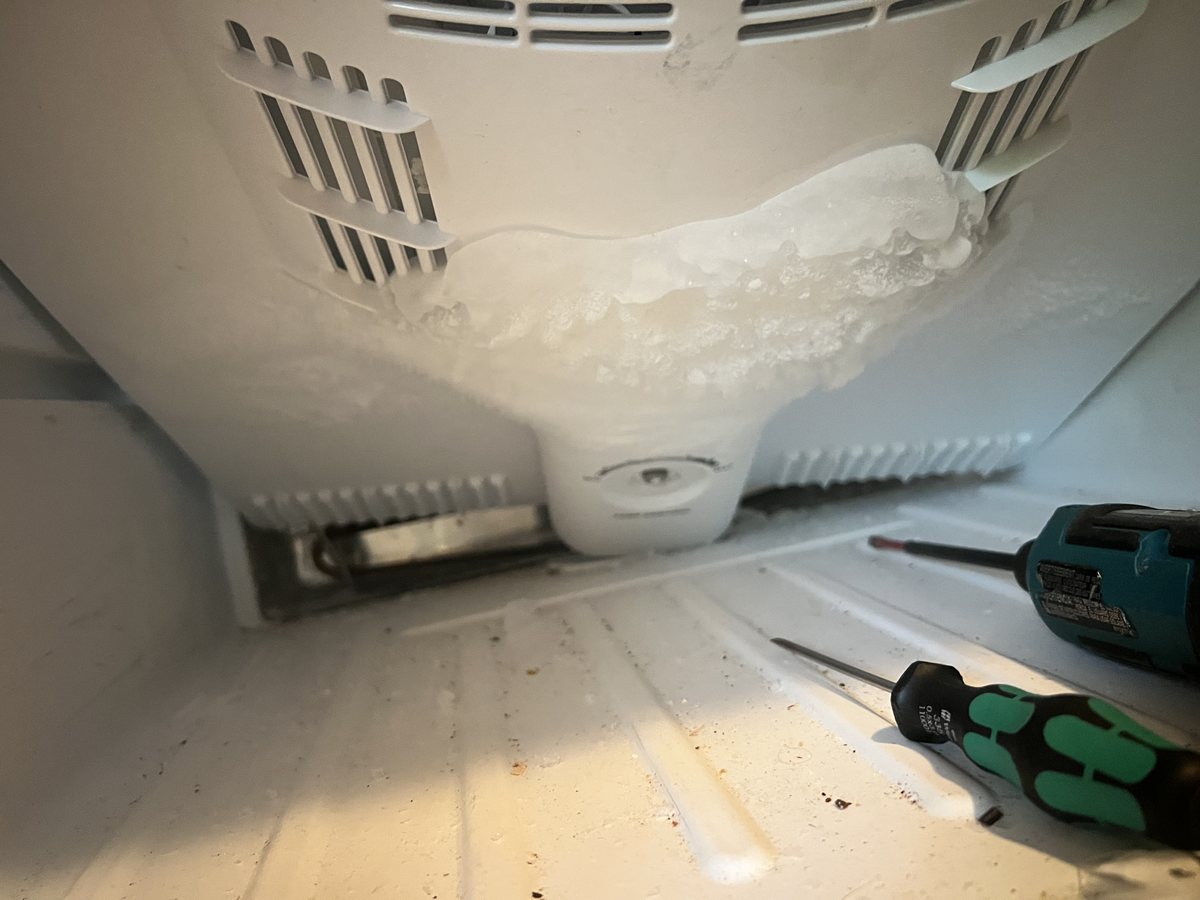
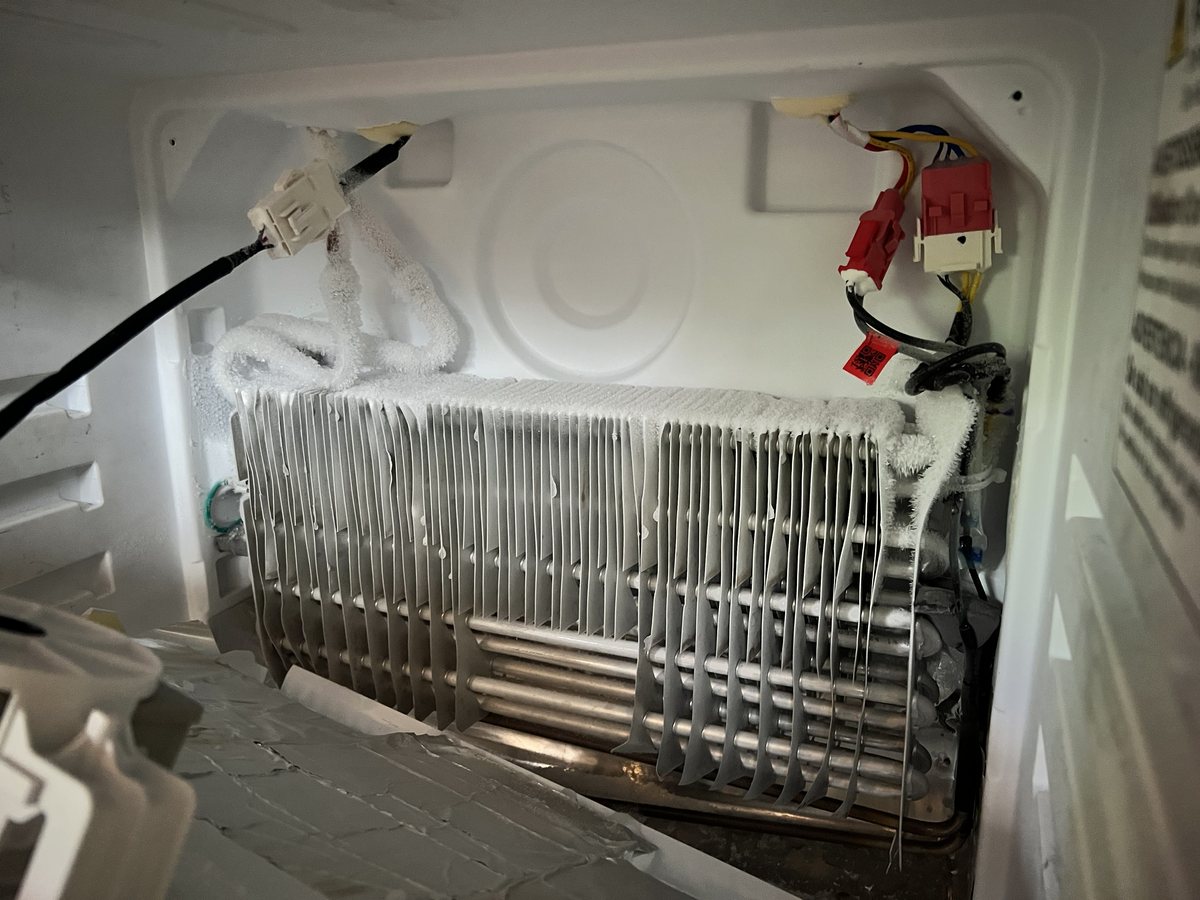
If you see a sheet of frost or a block of ice on the back wall of the freezer, the defrost system may not be working. A manual defrost can get the fridge cooling again for a while. Move the food out, unplug the fridge, leave both doors open with towels down, and let the ice melt on its own. Do not chip at it with a knife or other tool, which can puncture the coil.
If the ice comes back within days or weeks, the defrost heater, thermostat, sensor or control has likely failed, and that needs a repair.
7. Both fridge and freezer warm
If both compartments are warm, the coils are clean and the condenser fan is running, the cause is usually deeper. iFixit points to the condenser fan or coils, the control board, or the sealed system: the compressor and refrigerant circuit.
Signs that point toward the compressor or sealed system include a compressor that clicks on and off every few minutes, a fridge that runs all the time without getting cold, or an oily spot on the tubing. This is not a DIY job. Repairs to the sealed system need a technician with refrigerant handling training.
What each result usually means
| What you found | Most likely cause | Next step |
|---|---|---|
| Reading just above 4 °C | Setting too warm, door opened often, warm food loaded | Lower the setting, wait 24 hours |
| Fridge warm, freezer cold | Blocked vents, failed evaporator fan, stuck or iced damper | Clear vents; if that does not fix it, book a repair |
| Frost or ice on the freezer back wall | Defrost heater, thermostat, sensor or control fault | Manual defrost, then book a repair |
| Both warm, coils dusty | Condenser cannot release heat | Clean the coils and retest |
| Both warm, coils clean | Condenser fan, control board, compressor or refrigerant | Book a repair |
| Fridge runs constantly but stays warm | Sealed system or airflow fault | Book a repair |
| Fridge completely silent and dark | Power, control board | Check the outlet and breaker, then book a repair |
How we diagnose a fridge that is not cooling
Our refrigerator data study, Most Reliable Refrigerator Brands: What 7,027 Repairs Show, looked at fridge and freezer jobs from May 2023 to October 2026. “Not cooling” was the most common complaint, at 47.6% of the 5,483 jobs with fault notes. Sealed system or compressor work came up in 7.2% of those jobs. If you are wondering whether your brand is worth repairing, that study breaks the numbers down by brand.
On a typical not cooling call, our technician will:
- Measure the temperatures in both compartments and check the settings.
- Check the door seals and the condenser coils.
- Test the evaporator and condenser fans and look for ice on the evaporator coil.
- Test the defrost system, damper and sensors.
- Check whether the compressor is starting and running normally.
Once the fault is found, the technician explains the repair options, so you can decide whether the fridge is worth fixing.
Keep your food safe while you wait
Keep the doors closed as much as you can. A closed fridge holds its cold far longer than one that is opened every few minutes. Use a thermometer to check, and move meat, fish, dairy and leftovers to a cooler with ice packs if the fridge goes above 4 °C.
Health Canada notes that you cannot tell if food is unsafe by its smell or taste, and its advice is simple: when in doubt, throw it out.
When to call a technician
Book a repair if:
- The fridge is still above 4 °C 24 hours after you adjusted the setting and cleared the vents.
- The freezer is cold but the fridge is warm and the vents are clear.
- Ice keeps building up on the freezer back wall.
- A fan is silent, grinding or squealing.
- Both compartments are warm and the coils are clean.
- The compressor clicks on and off repeatedly or runs nonstop.
Our refrigerator repair in Surrey covers standard and high end fridges and freezers. We serve Surrey, South Surrey, White Rock, Langley and Delta, with same day and next day appointments.
What a fridge repair costs with us
We cannot price a repair until a technician has seen the fridge, because a warm fridge can be anything from an iced damper to a compressor problem. Once we have thoroughly diagnosed your appliance, we quote the parts and labour for the repair. Here is how our published rates work:
| Item | Rate |
|---|---|
| Diagnostic, every brand (for example Whirlpool, Maytag, KitchenAid, Frigidaire, Samsung, LG, GE, Sub-Zero, Bosch, Thermador, Liebherr, Fisher & Paykel) | $100, credited towards your repair labour |
| Repair (parts and labour) | Quoted once we have thoroughly diagnosed your appliance |
| Specialty repairs (for example sealed systems, built in appliances, double wall ovens) | Quoted separately after the diagnostic |
The diagnostic covers the service trip and the time spent diagnosing your appliance, whether that is 15 minutes or 2 hours. If you decide not to go ahead with the repair, you only pay the $100. Specialty repairs, such as sealed systems, washing machine transmissions, built in appliances and double wall ovens, are quoted separately after the diagnostic. Repairs carry a 3 month guarantee on parts and labour, with extended guarantee options available.
Frequently Asked Questions
Why is my fridge not cooling but the freezer is?
Most fridges cool both sides from a single coil in the freezer. A fan pushes cold air through a damper into the fridge. If food blocks the vents, the fan fails, the damper sticks or ice covers the coil, the freezer stays cold while the fridge warms up.
What temperature should my fridge be?
Health Canada recommends 4 °C (40 °F) or lower for the fridge and -18 °C (0 °F) or lower for the freezer. Use a thermometer to check, because the setting on the display is not the actual temperature.
Can I fix my fridge myself?
You can check the power, settings, vents and door seal, clean the condenser coils and do a manual defrost. Testing and replacing fans, defrost parts and control boards is best left to a technician. Compressor and refrigerant repairs always need a trained technician.
How long does it take a fridge to get cold again?
After you change a setting or finish a manual defrost, give the fridge about 24 hours before you judge whether it is cooling properly. If it is still above 4 °C after that, book a repair.
How much does it usually cost to repair a fridge?
It depends on the fault. With us, the diagnostic is $100 for every brand, and it is credited towards your repair labour. Once we have thoroughly diagnosed your appliance, we quote the parts and labour for the repair. If you decide not to go ahead, you only pay the $100 diagnostic.
Sources
- Health Canada: Safe food storage (retrieved 2026-11-02)
- iFixit: How to troubleshoot cooling issues in an LG refrigerator (retrieved 2026-11-02)
- Surrey Appliance Service Pros: Most Reliable Refrigerator Brands, What 7,027 Repairs Show (May 2023 to October 2026 job data)
- Featured image: “Food Safety: Cut Waste in Refrigerators”, U.S. Department of Agriculture photo, Wikimedia Commons, public domain, cropped and resized.
About the authors
This guide was written by the Surrey Appliance Service Pros team using our technicians’ notes from fridge and freezer repairs. We have repaired appliances in Surrey since 2015, and our technicians hold Red Seal tickets. If something here is unclear, contact us.
Need a fridge repair in Surrey?
If your fridge is still not cooling after these checks, we can help. See our refrigerator repair service, book online, or call (778) 488-8751. Surrey Appliance Service Pros, 9850 King George Blvd 3rd Floor, Surrey BC V3T 0P9. We are open 8 AM to 8 PM, seven days a week.
