
Worried about your expensive Vancouver appliances getting fried during the next power outage? You’re absolutely right to be concerned: these electrical disasters happen way more frequently than most homeowners realize, and they can turn your favorite kitchen gadgets into expensive paperweights faster than you can say “storm surge.”
Picture this nightmare scenario: you’re chilling at home during one of Vancouver’s infamous Pacific Northwest storms when suddenly the lights flicker, everything goes black, and when BC Hydro restores power hours later, your smart fridge isn’t cooling, your gaming console won’t boot up, and your expensive coffee machine is displaying cryptic error codes. This isn’t just an inconvenience: it’s a financially devastating reality that thousands of Vancouver homeowners face every storm season, often without realizing that the real damage happens when the power comes back on, not when it goes out. If your fridge is already struggling, our technicians provide refrigerator repair in Surrey.
What makes Vancouver’s power outage situation particularly tricky is our unique combination of coastal challenges. We’ve got those intense autumn windstorms rolling in off the Pacific, an aging electrical grid struggling to keep up with our growing population, and salt air that slowly corrodes electrical components over time. Meanwhile, Schneider Electric Canada estimates that a modern home has about $15,000 worth of electronics, and many of today’s appliances have surge-sensitive control boards. BC Hydro reported record-breaking outages affecting over 1.4 million customers in 2024, and each restoration event creates perfect conditions for appliance-destroying power surges. Our guide to appliance insurance claims explains what to document.
The good news is that you don’t have to be a victim of electrical mayhem. With the right knowledge about surge protection, outage protocols, and post-power restoration safety checks, you can turn your Vancouver home into a fortress against voltage spikes and keep everything from your morning coffee maker to your home office setup safe and sound. Let’s dive into everything you need to know to protect your appliances from preventable electrical disasters, because nobody has time or money for appliances that die from completely avoidable power surge damage.
Key Outtakes:
- Vancouver homes experience approximately 20 power surges daily, with most being internal surges caused by appliances cycling on and off during normal operation
- Schneider Electric Canada estimates a modern home has about $15,000 worth of electronics that a power surge can damage.
- Power restoration often creates more dangerous electrical conditions for appliances than the initial outage itself
- Post-outage appliance inspection within 24 hours can prevent secondary damage and preserve warranty claims for electrical incidents
- Most standard homeowner insurance policies don’t cover power surge damage without additional equipment breakdown coverage
Understanding Vancouver’s Unique Power Outage Crisis
Let’s get real about what we’re actually dealing with in Vancouver when it comes to power outages and appliance protection. Our city faces a perfect storm of electrical challenges that most other Canadian cities simply don’t experience. Between our notorious Pacific Northwest storms, aging infrastructure, and unique coastal environment, Vancouver homeowners are playing electrical roulette every time the weather gets sketchy. The statistics are honestly pretty scary when you start adding up the financial risk sitting in your home right now. Our rainy season appliance guide covers the damp weather checks.
BC Hydro dropped some shocking numbers recently: they reported power outages affecting over 1.4 million customers in 2024, representing nearly three-quarters of all British Columbians. That’s not just an inconvenience statistic; each of these outage events creates perfect conditions for appliance-destroying power surges when electricity gets restored. The region’s worst storms have intensified over the past five years, and climate change is making these weather patterns even more unpredictable across our province. One example happened in North Vancouver’s Pemberton Heights after the November 2024 windstorm, when a damaged transformer sent a surge through at least 33 homes and a local councillor estimated the appliance damage at around $300,000, according to the North Shore News.
What most Vancouver homeowners don’t realize is that your house is quietly experiencing approximately 20 power surges every single day, even when everything seems perfectly normal. These aren’t dramatic lightning-strike events: they’re sneaky internal surges that happen every time your dishwasher kicks on, your furnace cycles, or your refrigerator compressor starts up. Think of it like having tiny electrical earthquakes happening in your walls constantly, gradually weakening the delicate electronic components inside all your appliances over months and years.
Vancouver’s coastal climate adds another layer of complexity that inland communities don’t face. Our salt air gradually corrodes electrical components, making appliances more vulnerable to power fluctuations over time. High humidity levels common in our coastal environment can cause electrical component failures that often appear as random manufacturing defects, when they’re actually environmental damage. This means your appliances are essentially getting softer targets for power surges as they age, especially if they’re not properly protected from day one.
The financial vulnerability in Vancouver homes becomes staggering when you actually add up all the electronics and appliances at risk. Modern smart appliances are essentially computers disguised as household equipment: your Wi-Fi-enabled refrigerator, connected washing machine, and smart thermostat all contain sophisticated electronic components that are exponentially more sensitive to electrical fluctuations than the simple motors and heating elements in older appliances. When Vancouver’s electrical grid struggles during peak demand or weather events, these high-tech devices become sitting ducks for voltage spikes that can permanently damage their delicate circuitry.
Pre-Outage Appliance Protection Strategies
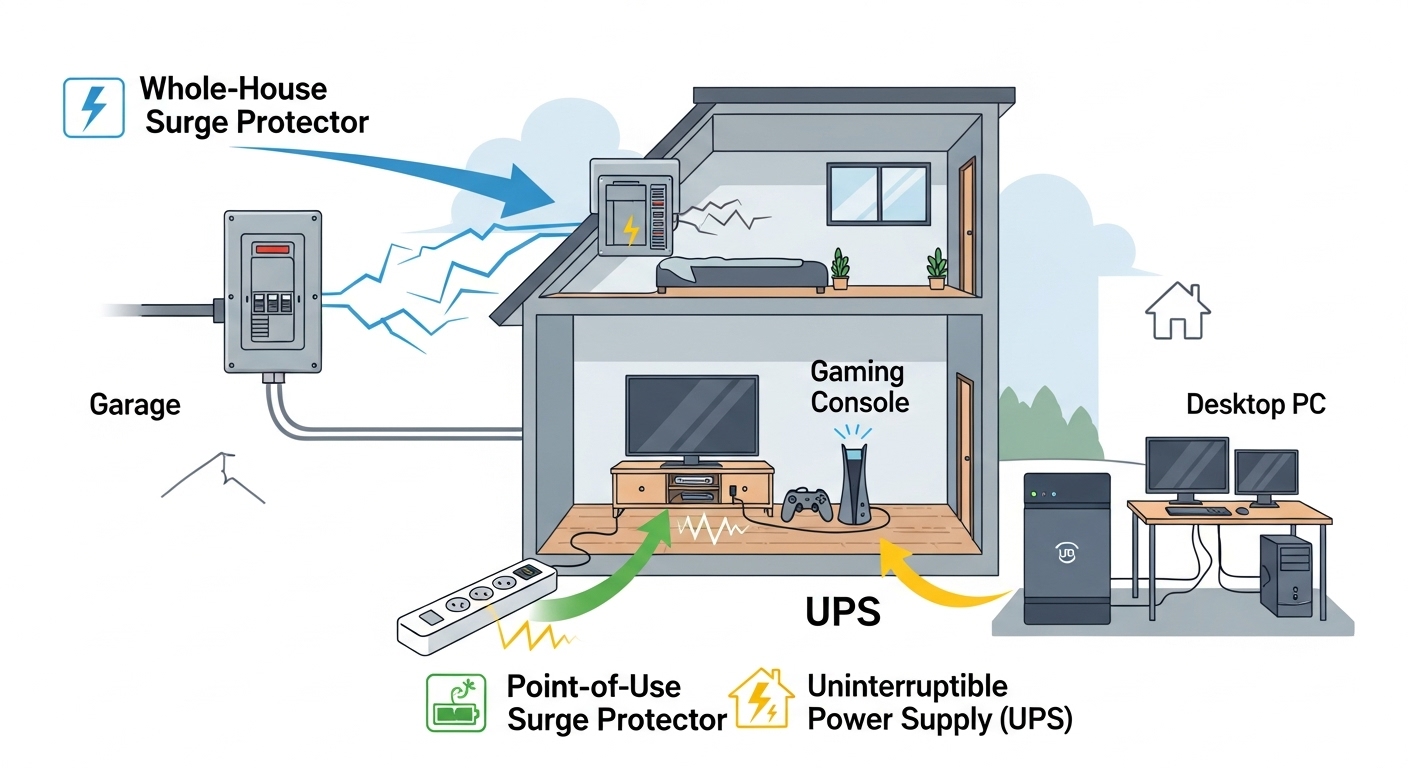
Now that we’ve thoroughly freaked ourselves out about Vancouver’s electrical challenges, let’s talk about the proactive steps you can take to protect your appliances before the next storm hits. The key to appliance survival isn’t just reacting to outages: it’s building a comprehensive defense strategy that works 24/7, because remember, those 20 daily power surges are happening whether you’re paying attention or not. The best protection strategies layer multiple types of surge protection to create redundant safety nets for your valuable electronics.
Whole-house surge protectors are your first and most important line of defense, and they get installed directly at your main electrical panel by a qualified electrician. These powerhouse devices create a protective shield around your entire home’s electrical system, intercepting voltage spikes before they can reach any of your outlets or appliances. When a surge comes racing down the power lines from BC Hydro’s grid, your whole-house protector diverts that excess electricity safely to ground before it can fry anything inside your home. The comprehensive coverage means you don’t have to worry about which devices are protected and which aren’t: everything connected to your electrical system gets the same high level of protection.
Point-of-use surge protectors are your second layer of defense, and these are the power strips and plug-in devices that most people are familiar with. While they can’t handle massive surges like direct lightning strikes, they’re excellent for catching smaller voltage spikes and providing extra protection for your most sensitive and expensive electronics. Look for models with high joule ratings, which indicate their capacity to absorb electrical energy, and low clamping voltages, meaning they kick into action quickly when a surge hits. Remember that surge protectors aren’t immortal: they have limited lifespans and experts recommend replacement every 3-5 years, especially in coastal environments where salt air accelerates component degradation.
Uninterruptible Power Supply systems, or UPS devices, deserve special mention because they pull double duty by protecting against both surges and outages. These are particularly valuable for home offices, computer setups, and any devices where losing power suddenly could cause data loss or other problems. A quality UPS provides clean, consistent power during brownouts and blackouts while also offering surge protection when the grid is functioning normally. For Vancouver’s tech-savvy homeowners with expensive computer equipment, gaming setups, or home offices, a UPS investment can literally pay for itself the first time it prevents data loss during an unexpected outage.
Strata building residents face unique challenges that single-family homeowners don’t encounter. Vancouver’s numerous condominiums and townhouse complexes have shared electrical systems where one unit’s electrical issues can cascade to neighboring units. This interconnected vulnerability means that surge protection becomes even more critical, and residents should consider both individual unit protection and advocacy for building-wide surge protection at the main electrical service entrance. Home Systems and Appliance Breakdown coverage becomes essential for strata residents due to these shared utility vulnerabilities, especially in older Vancouver heritage buildings with outdated electrical panels that may not handle modern power demands effectively.
Professional electrical system inspections should be part of your Vancouver home maintenance routine, just like checking your roof or cleaning your gutters. A qualified electrician can identify potential vulnerabilities in your electrical system, recommend appropriate surge protection solutions, and ensure that your home’s wiring can safely handle modern appliance loads. This is particularly important for Vancouver’s older neighborhoods where electrical systems might need updating to meet current safety standards and protect against the increasing frequency of power disturbances.
What to Do During a Power Outage
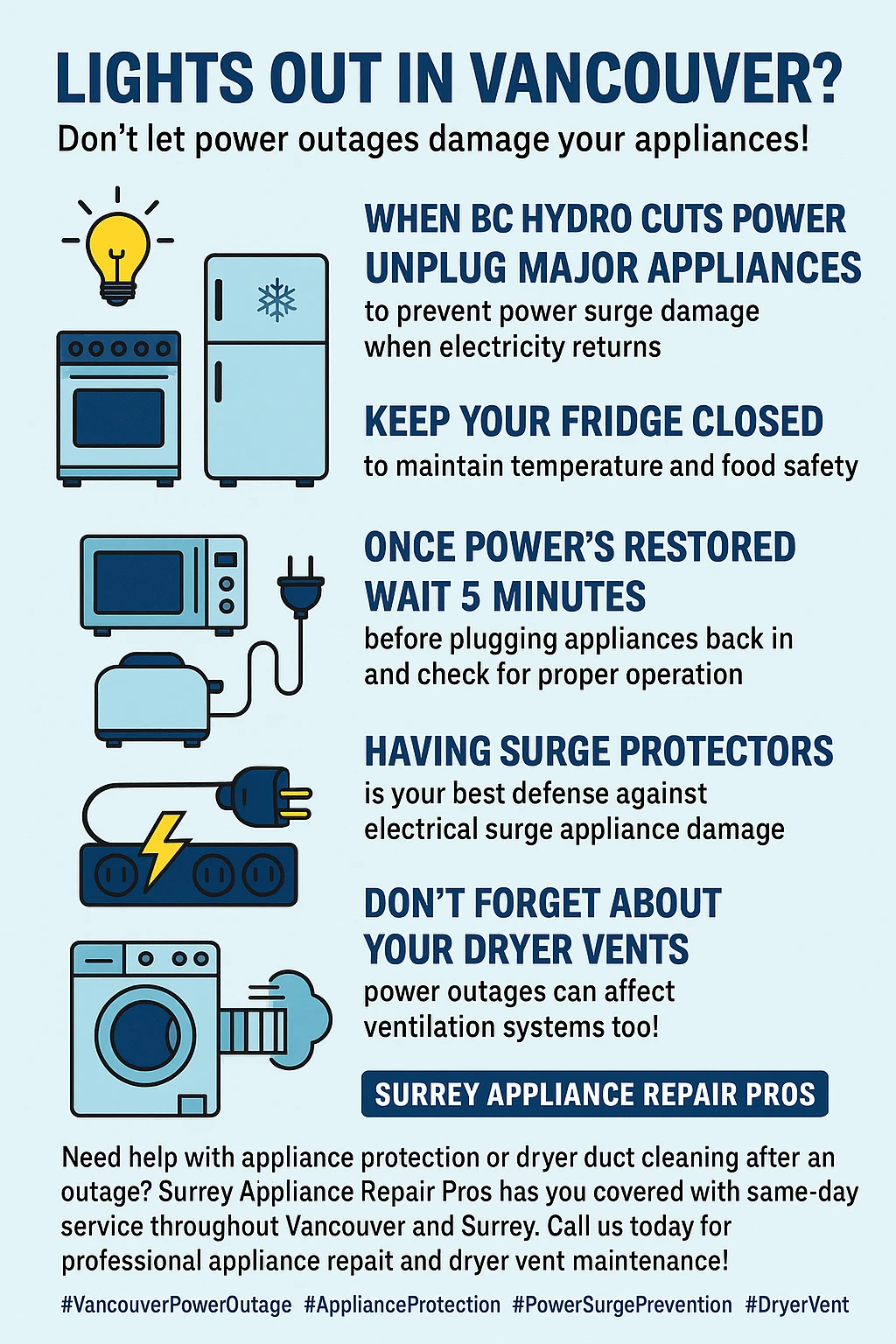
When the lights go out, the goal is simple: keep the cold in, take the load off your circuits, and make it easy for your appliances to restart safely when power comes back.
- Keep the fridge and freezer closed. Health Canada says an unopened refrigerator keeps food cold for about 4 hours, a full freezer keeps food frozen for about 48 hours, and a half-full freezer for about 24 hours (Health Canada, food and drinking water safety in an emergency). Every time you open the door, you shorten that window.
- Unplug sensitive electronics. Computers, TVs, game consoles and countertop appliances with control boards should come off the wall until power is stable. That way the restoration surge has nothing to hit.
- Switch off large appliances at the controls. Turn the range, oven, dryer, washer and dishwasher off so they don’t all try to start at the same moment the power returns. If a cycle was running, cancel it.
- Leave one light switched on. A single lamp tells you the power is back without every appliance in the house restarting at once.
- Check the outage map, not the appliances. BC Hydro’s outage map shows whether the outage is on your street or wider, and gives a restoration estimate when one is available.
- Don’t move frozen food outside. Health Canada advises against it, even in winter, because animals and sunlight can spoil it. If the outage looks long, ask a friend or family member with power to store your food.
Never run a generator, barbecue or camp stove indoors or in a garage to keep the kitchen going. If you use a portable generator, plug appliances into it with a proper outdoor-rated cord, and never connect it to your home’s wiring unless an electrician has installed a transfer switch.
What to Check When the Power Comes Back On
The first few minutes after power is restored are when voltage is least stable. Wait until the power has stayed on steadily for a few minutes before you plug electronics back in, then bring appliances back one at a time.
- Fridge and freezer first. Listen for the compressor and fans to start within a few minutes. Check that the freezer still feels hard-frozen and the fridge is cold. A fridge thermometer should read 4°C or below and the freezer -18°C or below, the settings Health Canada recommends.
- Sort the food. Food that still has ice crystals or feels refrigerator-cold can be refrozen. Throw out food that has been at room temperature for 2 hours or more, and anything with an unusual colour or smell. When in doubt, throw it out.
- Reset clocks and control panels. Ranges, microwaves and some dishwashers show a flashing clock or an error code after an outage. A reset usually clears it. If the same code comes back, write it down for your technician.
- Run one short cycle. Run the dishwasher and washer on a short cycle and the dryer on a timed dry. You’re checking that each one fills, heats, spins and drains the way it did before.
- Check breakers and GFCI outlets. A tripped breaker or a GFCI outlet in the laundry room or kitchen can look like a dead appliance. Reset them once. If a breaker trips again, leave it off and call an electrician.
- Take notes and photos. If something doesn’t work, note the date of the outage, what the appliance is doing, and any error code. Our guide to appliance insurance claims explains why that record matters.
Warning Signs That Need a Technician
Stop using the appliance and book a repair if you notice any of these after an outage:
- A burning or hot plastic smell, or a scorch mark on a plug or outlet
- The fridge runs but doesn’t get cold after several hours, or the freezer starts to soften
- A control panel that stays dark, freezes, or shows the same error code after a reset
- A compressor that clicks on and off without starting, or a loud hum with no cooling
- A washer, dryer or dishwasher that powers up but won’t start, heat, or drain
- A breaker that trips each time you turn one appliance on
Don’t open control panels or test wiring yourself. Boards and compressor parts can hold a charge, and a home repair attempt can also make a warranty or insurance claim harder.
Getting Your Appliances Back to Normal in Surrey
Most appliances come through a short outage with nothing more than a reset. The ones that don’t usually show it within the first day: a fridge that won’t cool, a board that won’t respond, or a dryer that won’t heat. Keeping the doors shut, unplugging electronics, and restarting appliances one at a time gives them the best chance.
If something isn’t right after the power returns, our technicians can come to you. We’re a mobile appliance repair team serving Surrey, South Surrey, White Rock, Langley and Delta, open 8 AM to 8 PM with same day service available. Start with our refrigerator repair in Surrey page if your fridge or freezer has stopped cooling, see all of our appliance repair services, or book a visit online.
Featured image Photo: h080, CC BY-SA 2.0, via Flickr.
